Clay
Clay properties, their mineral composition and the six groups of clays in Slovenia.
Clay properties
In order to determine the usefulness of clay, the following properties are essential:
- mineral composition
- granulation composition
- physical properties, such as plasticity, porosity, viscosity and the thixotropy of clay suspension in water, etc.
These properties are reflected in the properties of fired products, such as:
- shrinkage after drying and firing
- loss of ignition
- porosity
- shard colour
- compressive and bending strength
- clinkerization temperature and sintering interval
Mineral composition
Clays are clastic sedimentary rocks whose main mineralogical characteristic is the high content of clay minerals in fine fraction below 2 microns. The clay minerals are layered (phyllo) silicates and by their chemical composition, aluminosilicates. According to their crystal structure, they are classified into six groups of which the most important are:
- kaolinite
- montmorillonite
- illite and
- chlorite groups
The basic properties of clay depend on the main or most represented clay minerals or groups of minerals. The clay minerals from the montmorillonite group, which cause material swelling, are not desirable for ceramic and brickworks use. If the clay minerals from the kaolinite group are predominant in clay, such clays are relatively less plastic.
The main minerals that are found in clay: clay minerals, quartz, feldspars (plagioclases and K-feldspars), mica, etc.
The minerals that are common in clay: carbonates (e.g. calcite, siderite, rhodochrosite …), amphiboles (e.g. hornblende …), Fe and Al oxides and hydroxides (e.g. hematite, magnetite, goethite, lepidocrocite), sulphates (gypsum, anhydrite), apatite, pyrite, etc.
Map
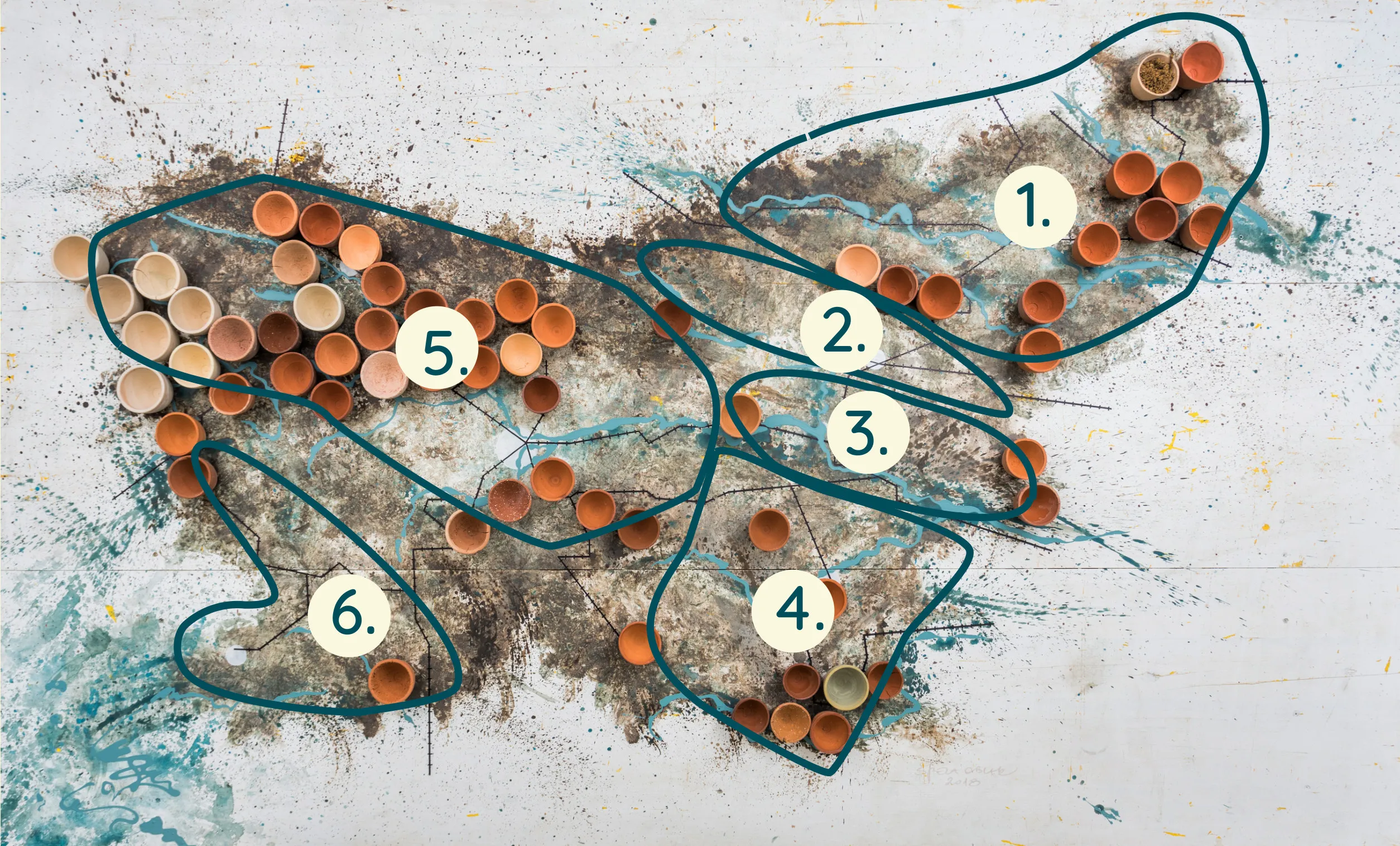
- 11st group
- The clays of eastern Slovenia, the Pomurska region, the Prekmurje region, the Podravska region, the chlorite and chlorite-illite type (Lendava, Dolga vas, Boreci, Hardeška šuma, Bomčev breg …). Montmorillonite-illite clays in Janežovci.
- 22nd group
- The clays of the surrounding area of Celje are of the kaolinite and kaolinite-illite type (Zadobrova, Šmiklavž, Lipovec-Glinsko, Pristava, Liboje …).
- 33rd group
- The coaly clays from the Central Sava Valley coalfield are of kaolinite-illite type (Trbovlje, Laško …).
- 44th group
- The clays on the karst limestone in the periphery of the coal cave of Lower Carniola, Inner Carniola and White Carniola belong to different types of clay minerals.
- 55th group
- The clays of the Pleistocene Kamnik-Savinja Alps and the Julian Alps are of the illite and illite-kaolinite type (Vrhnika, Sinja Gorica, Smodinovec, Stražišče …).
- 66th group
- The clays on flysch are of the illite and illite-kaolinite type (Ilirska Bistrica, Okroglica, Renče …).
Duška Rokavec